Showing posts with label Others. Show all posts

Friday, June 24, 2011

Beer's Tower at Ibadan

If you went to Ibadan, you would know that the City of Brown Roofs is distinguished in many ways: the city spreads on and on and on with neither end nor pattern; the roofs are indeed red-brown with sparkles of other colours here and there. Also, you would notice that there is refuse everywhere you turn--as much refuse as you want. Pace-setter town, Ibadan houses the first Nigerian university, the first TV station in sub-Saharan Africa, a national museum, the national archives and many more.


But few tourists visit these landmark places. Why? Ibadan does not need a tourist centre because the entire town is one big tourist fascination. Many people visit Bower's Tower in Ibadan, a colonial legacy that allows you to see a huge part of Ibadan and then conclude that you haven't seen a quarter of it. My friend and I visited Bower's Tower recently and were unhappy with the sight (especially the stench and the refuse on the way to the Tower). Bent on impressing my friend, I took him to another Tower which I call Beer's Tower--salute to Nigerians' creativity!


How on earth do they get to the top of this?


Saturday, December 25, 2010

This Dart Hits Me III: Not a Merry Xmas

Christmas Eve saw evil descend on Jos and Maiduguri. On Friday 24, three bombs exploded in Jos--two in busy Jos markets and one in a Catholic church. Over thirty people were killed in Jos; several more wounded. In Maiduguri, a church was burnt and a pastor and two others were killed.

My friend, John Galadima, lives in Jos with his family. John teaches Mass Communication in University of Jos, Nigeria. But he was in Ibadan this season to get ready for the final defence of his PhD thesis coming up soon. When John got the news that his hometown was in flames, he was totally crestfallen. He spent nearly all on him making calls to his wife and relatives. In the evening, John had to take a shot of local gin to douse his rising restlessness. Thank God, his family members were not harmed. Contrary to tradition, I decided not to send any SMS this year wishing anyone merry Xmas. It was not a merry Xmas.

What is sad about all of this is that there had been clear signals that there would be attacks during Christmas in Jos. Five days before dropping the bombs in Abuja on October 1, militants warned government; days before Boko Haram invaded the Bauchi prison and set their bloodhounds free, government got wind of it. All of the recent blasts, attacks, massacres were preceded by what is more than rumours of the atttacks. And don't think that the Nigerian security agents are dumb asses. They are simply overstretched protecting the rich political class. Merry Xmas?

Tuesday, December 7, 2010

This Dart Hits Me--Part II (Darkness Covers the Land)

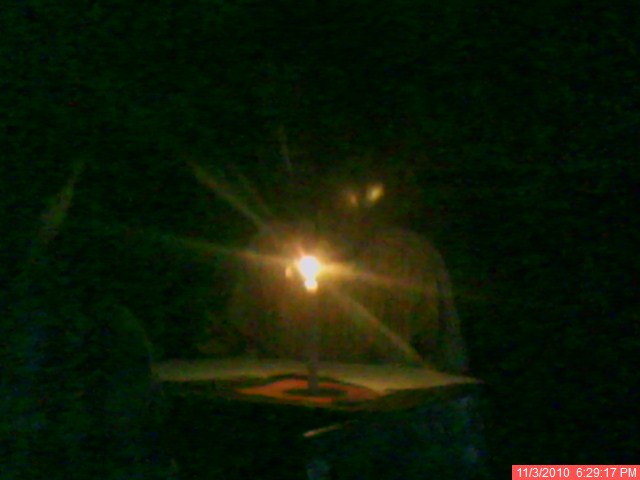
The promise of the Federal Government was to increase electricity supply to 6,000 megawatts by December last year (2009). Well, like many other promises from government, that failed woefully. Right now, the 120million people in Nigeria survive on less than 2,000 megawatts. I wrote on this in an earlier post on this blog: Home Sweat Home. Most Nigerians have adjusted to the darkness and frustration created by the absence of electricity--as well as to the hellish noise created by generators used by neighbours. For six weeks, there was no electricity supply to the building that houses my faculty. That did not bother me too much. What recently hit me was this: university students having to write exams with candles. It was an evening paper and by 6pm it was dark already. The lecturer in charge had to provide candles so that the exam could continue! See pictures following--if you can see anything! Tomorrow, the government will complain Nigerian students aren't performing as good as their counterparts elsewhere. They will lament that Nigerian universities aren't among the top 1,000 in the world. And they always blame lecturers for that.
Saturday, November 20, 2010

This Dart Hits Me: Part I--Yomi Fashina is Dead


In April this year when I returned from a three-month fellowship at the African Studies Centre, Leiden, the Netherlands, I took a decision: I would be totally indifferent to any of the problems which have come to define Nigeria. I had met the electric power supply worse than it was three months earlier, the roads were worse... in short everything had gone worse including the health of the then president. I had always carried with me the burden called Nigeria. I was given to staying up at night worrying about Nigeria; soliloquizing during the day about the problems of Nigeria, and often giving vent to my frustrations about Nigeria at seminars and during lectures. Now, I decided ‘No More’. Nigeria was not my property or business. I constructed a mental and emotional cocoon, an iron shell into which I often withdraw, far away from Nigeria. But Nigeria is a good marksman and its dart keeps perforating my cocoon and hitting me. This One Hits me Sore!

The worst dart Nigeria has thrown at me since I withdrew into my cocoon was thrown on Tuesday November 9. My student, research assistant and friend, Oluyomi Dipo Fashina (DF) was returning from Lagos on the notorious Lagos-Ibadan Expressway. The bus in which he was travelling was involved in an accident. Yomi had several compound fractures in different parts of his body. Gallantly, Yomi fought the pains for five long days. In between spells of comas, Yomi was able to speak once. All he said was that everyone should relax; he would be fine. In the evening of Sunday 14 November, DF died. The Lagos-Ibadan Expressway had its way!

.
If anyone came close to being a perfect gentleman, Yomi was that person. A great team player, an ever-smiling workaholic, a leader and a true servant of men. Yomi, with like-minded classmates like Chuks Egbunike, John Ibanga and Folake Ogunleye, did a comprehensive fieldwork for me on mobile phone deception in Nigeria. And together we explored the Communication Infrastructure Theory and its possible applications in Nigeria. Several times he was my extra pair of eyes which picked my un-dotted i’s and uncrossed t's. He was there for me literally at the snap of a finger!

Since Yomi’s death, everywhere I turn, I encounter him: his MA thesis is on my shelf and on my table; his writings are in my files; his documents are on my laptops. Where do I turn from you, Oluyomi? My colleagues and students meet me and console me as you do one who lost an only child.


If the Lagos-Ibadan Expressway was good, if Vehicle Inspection Officers did their job, in short, if this was not Nigeria, Yomi would be alive today. In the last ten months, the Lagos-Ibadan Expressway (on which Yomi had the accident) has claimed about two hundred lives through accidents. The accidents included several occurrences of fuel-carrying tankers which lost control and ran into many passenger vehicles burning everyone to ashes. Women, men, children, newlyweds on their way to their honeymoon—all dreams are being cut short. We moan and groan and keep quiet. The dead become mere statistics. The road is bad, the vehicles are bad, drivers are unlicensed, policemen are busy with N20 bribes and the government is busy with elections and rigging, while Nigerians are dying in their prime!

Nigeria, it’s hard not to be hard hit.

Saturday, May 15, 2010

HOME SWEAT HOME: ‘It’s Our Day of Electricity’

I returned to Nigeria few weeks ago and discovered a most ingenious thing that PHCN has done. PHCN is the agency in charge of electricity in Nigeria. PHCN has developed a remarkably intelligent power rationing scheme in the city of Ibadan where I live. In my section of town, we get electricity every other day. The week of my arrival, we "had it" on Sunday, Tuesday, Thursday and Saturday. Those were our days of electricity, days to really look forward to. But I was soon made to understand what ‘our day of electricity’ means. It means the day that you have the right to hope for electricity—not the right to have it! On such a day, you hope that there will be electricity. That is all you do the whole day--hoping.

In fairness to PHCN, we do have some electricity on those days: sometimes for just a few minutes during the whole day, other times—when we are really lucky—for up to three hours on such wonderful days.

But complete woe betide your section of town if you were careless enough, on your day of electricity, to allow rain to fall or strong winds to blow. Once any of these two evils is allowed, PHCN switches off electricity and you no longer can hope for even a ‘flash’ until your next day of electricity.

I also discovered that my neighbour has bought a mighty electricity generating set. He has also positioned it so strategically that the noise drones right into my bedroom thereby keeping me alert all night. Thanks, dear neighbour. It sure is great to be home, home SWEAT home.

Thursday, April 22, 2010

Anne Frank and the Jos babies: the crime that isn’t theirs

My friends, Daan and Thomas, and I passed by the Anne Frank House in Amsterdam. (Picture left). In this house, Anne Frank, her sister and her Jewish parents, hid from Hitler’s men and machinery during the World War II. (Their offence was that they were Jewish. Hitler was reaching for the jugular of every Jew). Here, Anne and her family hid for two years. Here she recorded her feelings and fears in a diary. Anne and her family were betrayed by a neighbour. They were arrested and taken to one of Hitler’s concentration camps. There Anne and her sister, Margot, died of typhus in 1945. Otto, her dad, was the only one who survived the war. From Anne’s surviving diary, movies have been produced and books written. Anne Frank House is a tourist centre today — see the long queue (picture below).

Anne’s case reminded me of the babies in Jos that were butchered in the dead of the night by herdsmen, earlier that week. The offence of the babies was that they were Berom and Christian just as Anne was Jew—an offence that wasn’t theirs.

Thursday, April 15, 2010

Somali Pirates: Robin Hoods or Criminals?

I found on the website of Radio Netherlands Worldwide (Africa) an article that represents the counter-dominant view of the 'piracy' war in Somalia. It's a brief and interesting article. Click here to read.

Thursday, March 11, 2010

Jos, Oh Jos!

Too sad to speak.

Thursday, February 18, 2010

Farida on Corruption

"Having dealt with many corruption cases, I am inclined to suggest that public officers (in Nigeria) should be subjected to some form of psychiatric evaluation to determine their suitability for public office. The extent of aggrandizement and gluttonious accumulation of wealth that I have observed suggests to me that some people are mentally and psychologically unsuitable for public office. We have observed people amassing public wealth to a point suggesting 'madness' or some form of obsessive compulsion" (Daily Trust, Oct 8, 2009; pg 64)

Tuesday, September 1, 2009

There is a Nigerian Spirit

There is a Nigerian spirit... and it is not a bad spirit. Recently, our youngest daughter was on admission at the University College Hospital (UCH) for a surgical procedure. UCH is top on the list of tertiary health facilities and teaching hospitals not only in Nigeria but also in West Africa. But news about UCH can be terrible: nagging nurses; uncaring doctors; consultants more interested in research than in patients, and stinking corruption. A friend of mine told me how his mum on admission at UCH needed oxygen and he paid for 12 cylinders of oxygen but got receipts for only two! Pretty much like what you hear about Nigeria. But not much different from what you hear about the Blagojevitchs, Halliburtons etc. of America!
My experience with UCH showed me something not often heard about Nigeria. My daughter had just been wheeled into the theatre and we were sure the surgical procedure was on when electricity went off! In Nigeria, we would say NEPA (or PHCN, that is, power authorities) took light. My heart skipped a beat. But right in the reception where we were, other medical teams were examining other patients including a six-week old baby. Pronto! All of them--nurses and doctors--brought out their handsets and switched on the flashlights! Each of the fifteen or so handsets had a flashlight. So the examination out there at the reception and, I imagined, my daughter's surgery right in the theatre continued under the light provided by the galaxy of twinkling flashlights. This event and several others I had at UCH (for instance, nurses and doctors raising funds for patients) showed that there is a Nigerian spirit--a great and indefatigable spirit. It is a spirit that achieves something working with nothing! This spirit works with nothing because of irresponsible and irresponsive national and state leadership. And sadly, it is a spirit that often goes unacknowledged in the national and international media.
This is not a campaign for the Nigerian government's rebranding exercise. As a matter of fact, I think the slogan of that exercise should read: Good people; great nation; bad leaders! (Not just 'Good people; great nation'). Rather, this is my attempt to celebrate a spirit we have trampled underfoot for ever so long.

Friday, December 12, 2008

Students who don't do assignments get A's

USA Today published an article which summarizes a nationwide survey of college students in the US. The study involved nearly 380,000 students from 722 four-year colleges. The study showed that about 20% of seniors and 25% of freshmen reported frequently going to class without completing the required readings or assignments. Yet, of these students who did not do their assignments, 29% of freshmen and 36% of seniors got mostly A's. Of what use, then, is going through the professor's readings? Read the article here.

Saturday, November 22, 2008

The Nigerian Higher Education Foundation symposium at New York

On Thursday, 13 November 2008, my colleague and I attended a symposium organised by the Nigeria Higher Education Foundation (NHEF) at Columbia University, New York. In attendance were several distinguished US-based Nigerians in academia holding down important positions in their fields and publishing cutting-edge research. Participants also included people from business and representatives of some higher institutions in Nigeria, including the University of Ibadan. In attendance was the Obi of Onitsha, an alumnus of Columbia University for forty years. (I stand with the Obi in the photo above)

The symposium was on the role of partnerships in African sustainable development. Participating organisations included the Earth Institute, Columbia University. Among the speakers at the symposium--and there were very many of them--were the distinguished Professor of Development Economics, Jeffrey Sachs; the Obi of Onitsha, Igwe Achebe; Anthony Olorunnisola (Penn State University); Ibrahim Gambari (United Nations); Wole Soboyejo (Princeton University); Bola Omoniyi (the Earth Institute); Funmi Olopade (University of Chicago); G.O.S Ekhaguere (University of Ibadan, Nigeria), and Sam Ofodile (UNIPORT, Nigeria). Some presenters shared their research breakthroughs (Prof Ofodile and his team had perfected a method of injecting a substantial quantity of protein into garri!) while others presented the activities of their organisations (Bola Omoniyi talked about the Millennium Villages Project in countries including Nigeria). Everyone stressed how their research or organisations could help, or had been helping, Nigeria especially with regard to attaining the Millennium Development Goals (MDG). Presenters however shared their frustrations with the situation in Nigeria: the difficulty in collaborating with Nigerian universities caused by lack of follow up; the daunting problem of bureaucracy in Nigerian universities; and cold reception or even outright opposition from colleagues back home! The problem of infrastructure and
corruption in the nation as a whole also received substantial coverage. (To your left is a discussion panel at the symposium. I stand with Dr Olorunnisola in the photograph below)

This symposium was my first real encounter with brain drain at work. The presenters were first-rate academics, distinguished in every sense of the word, who had left Nigeria years ago out of sheer frustration--unemployment, militarism, poverty, insecurity, corruption--or in search of education. Nigeria's loss is America's gain. It also exposed me to the reality of media bias and stereotypes: in the media we hardly hear of this category of Nigerians in the US; but all the time we hear of a different kind of Nigerians in America: those who defraud others. The symposium also exposed me to a different kind of patriotism. These people left Nigeria years ago but their hearts never left Nigeria. Everyone was driven by one question: "how can we help Nigeria?" In fact, that was the question that led to the birth of NHEF in 2004.

It appears to me that Nigeria has immense resources and an inexhaustible reservoir of goodwill from Nigerians in diaspora--resources which our leaders and administrators have ignored. Will Nigerian academic adminstrators and political leaders respond to the NHEF and diasporic beckon? I am frightened by the obvious answer to this question.

PS: Jeffrey Sachs's wisecrack at the symposium: Each time people complain about corruption in developing countries, I ask, 'Really? You mean there are corrupt people outside of Washington?'

Monday, November 10, 2008

'Yes we can'…it is real

No election ever sapped my physical and emotional energy as much as the recent US presidential elections. After witnessing electoral malpractices of indescribable dimensions and scale in Nigeria, I had come to the conclusion that elections in general are not worth the sweat. And as the US election approached and the dirty, dangerous and desperate fighting by the Republicans got worse, my cynicism turned to fear. That fear gripped me tightly. A few weeks to the election, it was clear that Barack Obama would win; but with the US Republicans, it is not over until they are under. The Republicans brought out all the lethal weapons in their arsenal: Obama’s birth certificate issue; Obama’s pastor, Pastor Wright’s racial venom; Obama’s neighbor, Bill Ayers’s ‘terrorist’ records; Obama Aunt’s illegal residence in the US; Obama’s promise to redistribute wealth which they called socialism; Joe the Plumber; Obama’s anti-Israel friend, Khalid …the list of smear dots was endless. For me, every new day brought fresh fears.

The elections came. I went monitoring and observing the process with two sets of news writing students of my host college, College of Communications. I visited three voting stations: two outside and one on campus. I was stunned by the fact that there was not a single policeman in any voting station; I was stunned that people went to vote carrying their children with them—who could do that in my country where people go to voting stations not sure they would return alive or in one piece. I was stunned by the sheer number of nonpartisan organizations out there to help voters find their way and precinct. I was stunned that elections were handled by the states, and not by the federal government. Therefore each state (even county) designed its ballot papers and voting method. I was stunned that, accompanied by Jennifer Zeigler, a colleague and an instructor in news writing, I was allowed right up to the ballot cubicle though it was obvious that I was not a citizen. I was stunned by the sheer list of things people voted on: it was not just the presidential and congressional candidates. Folks were asked, in Fergusson Township, to vote on tenure elongation for County Council members. That too was on the ballot papers. I was stunned by the spirit which kept people on the queue for five hours plus without them complaining. I was too stunned to write—that is why this piece is coming this late.

I met an old white lady at the voting centre in the HUB at Penn State University. She told me she was 76. She carried candies and water which she generously offered people who queued to vote. She wore Obama signs but her water and candies were for whoever wanted to vote—no matter who was their candidate. She had been there four hours when I got there; and was there standing while I left two hours after.

What was behind this spirit? Another colleague of mine, Dr Jo Dumas, who on that day wore the sign “Poll Monitor”, put it this way: “the message has sunk down into people’s hearts. If you want people, reach for their hearts”. I interpreted “the message” to be Obama’s message of change.

Polls closed in Pennsylvania at 8 pm. CNN began including Pennsylvania results in their announcements from 8:15 pm. Talk about the power of speed and technology. (In Nigeria, it took about a week for the 2007 election result to be released—which is what Professor Maurice Iwu, Nigeria electoral boss, wants the US to learn from us!)

My friends and I did not sleep even after CNN's Wolf Blitzer pronounced Obama winner about 11 pm, Eastern Time. “Was it real? Please pinch me! It’s a dream”, one of my friends said as the announcement was made. It is real.

Thursday, October 30, 2008

FREE JONATHAN ELENDU NOW!

The Nigerian blogger, Jonathan Elendu was, about two weeks ago, picked up by the State Security Services in Nigeria. He was detained for several days and was released on October 29, but his international passport was not returned to him. Jonathan Elendu is based in the US; without his passport, he cannot return to his family in the US. This is against the Nigerian constitution; it is against democracy and freedom of speech; it is against all sense of fairness. Free Elendu now! Return his passport to him.